




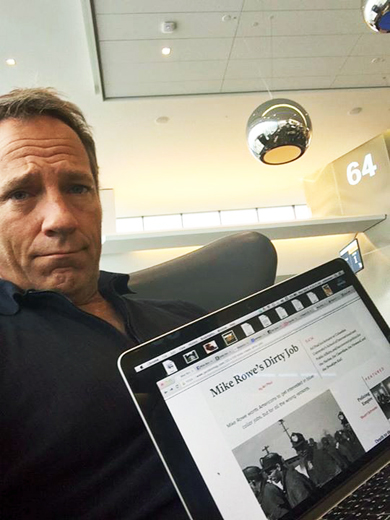
Mike, a friend of mine posted this article recently. “Mike Rowe’s Dirty Job.” While I fundamentally disagree with every point in it, I would love to hear your rebuttals to the personal attacks. Posted by Joey Defourneaux, 10:02 am, 9/7/2014
Thanks Joey
Happy to oblige. When my flight’s delayed, and my entire day goes to hell in a handcart, there’s really no better way to pass the time than by analyzing the thoughtful prose of a fake journalist who has the courage to make shit up.
The writer is a guy named Ari Paul, and the publication is called The Jacobin. Both appear to be slightly to the Left of Mao, which is fine by me. I’m friendly with many good-natured socialists. Ari however, does not approve of what I’m trying to do with mikeroweWORKS, and his reasons are chronicled below. I’ll leave it the objective reader to determine if those reasons are accompanied by something approaching logic or journalism.
AP: “Dirty Jobs is a television show in which host Mike Rowe visits and profiles people across the United States who do dangerous and overlooked work. Roadkill removers. Sewer inspectors. Those who dive into filthy water to scavenge for golf balls.”
Hi Ari –
True. Dirty Jobs profiled people who aren’t afraid to get dirty. Some were poor, some were middle-class, some were wealthy. Of the 300 jobbers we profiled, nearly half owned their own business. Many were prosperous, including the golf ball scavengers. It’s important to know that going in, lest we lapse into the trope that says dirty jobs are only for the unfortunate…
AP: “But it’s not just for kicks, Rowe insists. After several seasons, the host has become inspired enough to take his economic message beyond cable. Through the mikeroweWORKS foundation, allying with companies like Caterpillar, he provides scholarships for people interested in training for skilled trades — not just to promote his brand, but to advise the poorly paid and unemployed.”
MR: www.mikeroweWORKS.com was formed six years ago on Labor Day. It’s got nothing to do with my “brand,” but a lot to do with who I am. It’s true that I’ve offered advice, but very rarely, and only when asked. Mostly, I speak about my own reliance on skilled labor, and the need for our society to place a higher value on good jobs that too often go under-appreciated. My goal, from an advocacy standpoint, is to shine a light on jobs and educational opportunities that are being largely ignored, and encourage those who wish to learn a skill in demand.
AP: “Corporate sponsorship notwithstanding, it appears to come from the heart.”
MR: Thanks. In fact, it does. But the people supporting mikeroweWORKS are by no means limited to corporations. Moreover, corporate support does not indicate a lack of sincerity. Most jobs come from corporations. I welcome their support.
AP: “Rowe admires workers who don’t just get paid well but derive genuine happiness from creating something, fixing something, or doing the work others think is beneath them.”
MR: That’s true. I admire those people immensely. But I have not been empowered to speak on their behalf.
AP: “In interviews and in his brand Profoundly Disconnected, Rowe
asserts that Americans have been taught that the proper path to a good job and a good life is through education, with the punishment for doing otherwise a future of grueling, unrewarding physical labor.”
MR: What I’ve asserted, is that Americans have been misled with respect to the idea that one specific form of education – a four-year degree – is the best path for the most people. I strongly believe that some form of education/training is critical to success, and I’ve never suggested or implied otherwise. I’ve also argued that mechanical aptitude and academic aptitude are equally critical to our country’s future.
AP: “Welders, electricians, and other blue-collar workers have been so stigmatized that people otherwise inclined to join these professions are instead aimlessly looking at classifieds or stringing together unfulfilling office jobs while paying off mountains of student debt. There’s certainly a kernel of truth here.”
MR: A “kernel?” Seriously? For decades, parents and teachers have affirmatively discouraged kids from pursuing careers in the trades. The push for a four-year degree has been relentless, and now, the consequences are undeniable. Vocational education is gone from high schools, a trillion dollars in college loans is on the books, unemployment is still God-awful, and we have a widening skills gap. That’s a pretty big kernel.
AP: “For those without degrees or job training, the American economy
provides few options other than low-paying service sector jobs or soul-crushing clerical work with middling benefits.”
MR: That’s why I help people who wish to be trained. Even so – lots of people have turned low-paying service sector jobs and clerical work into stepping stones to something less… “soul-crushing.”
AP: “The twin scourges of de-unionization and slack labor markets have left many workers with little pay or workplace power. But Rowe isn’t concerned with the actions of business leaders, or government officials, or broader economic forces.”
MR: Sure I am. But I’m just one guy Ari, with a fairly modest foundation. I can’t focus on solving every single issue that plagues the US economy. I’m just trying to help a few individuals who wish to help themselves. But you seem to be suggesting that my interest in a “small” thing is indicative of my apathy for a “large” thing. That – as your masthead proclaims – would be “Reason in Revolt.”
AP: “To him the problem is the American worker herself, who is either indolent or unwilling to take the gross, dirty, hazardous jobs that are available.”
MR: You’re painting with an awfully broad brush. I would never personify the American Worker as a single entity, any more than I’d make generalizations based on race or gender. People who work for a living come in all shapes and sizes, with varying levels of ambition and work ethic. Some are industrious. Some are indolent. I prefer to make the distinction, because those qualities are choices, and right now, the country is bursting with people who genuinely believe that certain jobs are beneath them. I do not wish to reward those people.
AP: “It is not policy that needs reforming, but people.”
MR: Policies come and go, and I’m all for reforming the stupid ones. But look – I’m not an economist, or a philanthropist. I’m a guy who works on cable TV. I award work-ethic scholarships to those people who choose to pursue training programs that provide skills for jobs that actually exist. I do it because it makes me happy. I get that you would like me to do more, or act for a “better” reason. Well, tough titty.
AP: “Rather than shifts in global capitalism and the decay of the welfare state, Rowe believes the lack of well-paying jobs stems from the devaluation of hard, physical labor.”
MR: I have not talked about a “lack of well-paying jobs.” In fact, I know with certainty that they’re many good opportunities out there that simply don’t appeal to a lot of people, for whatever reason. This opinion is based on long conversations with hundreds of employers who are struggling to find the help they need. That’s been my experience, Ari. You may not like it, but there’s no need to be threatened by it.
AP: “Rowe’s ire also extends to the regulatory state, especially the Occupational Safety and Health Administration. The government has hindered job growth, he says, by forcing employers to put safety before production. Instead, he believes in a “safety third” system that lionizes the virtue of hard, often dangerous, work.”
MR: That’s silly, and patently untrue. I believe that worker safety is paramount. But I also believe that the whole “Safety First” protocol is a worn out platitude with consequences that are both unintended and counter-intuitive. Being “in compliance” and being “our of danger” are not the same thing, and when workers start to believe that someone else has put their safety “first,” complacency sets in. And from what I’ve seen, complacency is the biggest killer. “Safety Third” was an expression we used on Dirty Jobs to help cut through the complacency that arose from sitting through hundreds of mandatory briefings and compulsory safety briefings. Had you done a modicum of research, Ari, you would have found many explanations. Here’s one that almost anyone can understand.
Bottom line – companies have a responsibility to create a safe workplace by eliminating all the risk they can. But telling employees that “Safety is Our Number One Priority” is as dangerous as it is disingenuous. In fact, it’s insulting to anyone who takes a moment to really think it through. Accidents will always happen, and business will always march on. In my opinion, it’s best for the worker if she understands that going in.
AP: “Perhaps Rowe would like to explain his “safety third” idea to the family of Adam Weise, one of the eleven incinerated on the BP Deep Water Horizon oil rig in the Gulf of Mexico; or the relatives of Steven Harrah, one of the twenty-nine miners killed at the Upper Big Branch Mine explosion in West Virginia; or Joseph Graffagnino, one of two New York City firefighters who fatally asphyxiated in the infamous Deutsch Bank building fire across from the World Trade Center.”
MR: No thanks, Ari. I don’t think people who have lost family members need to hear me explain to them the obvious fact that corporations do not exist for the primary purpose of keeping their employees safe. I think that those people are pretty well up to speed with the fact that Safety is not Always first. Frankly, I think you’re using accident victims to make a completely fallacious point, in the same way you’re using me as a straw man. I find that rather cowardly.
AP: “Each joined a long list of workers treated as disposable, the victims of lethal accidents in worksites where safety was an afterthought. If Rowe cared more about them, he’d support the unionization that improves workplace safety — both through standard-raising contracts and the enforcement of OSHA regulations.”
MR: It’s irresponsible of you to suggest that I don’t care about those people. And it’s misguided to suggest that more regulation will save more lives. There have never been more safety regulations on the books than there are today. But still – accidents happen. More regulations won’t stop them. More human awareness might. If the company is at fault, hold them accountable. But the best way for me to improve worker safety is to talk directly to the worker. That’s what I’ve tried to do. I’ve tried to remind individual workers that no amount of government oversight or corporate compliance can replace the role of personal responsibility.
AP: “Nor is Rowe incensed by the policies that actively keep new workers out of blue-collar jobs and reduce the pay of existing workers.”
MR: You write as though you’ve interviewed me on the subject of “What Incenses Mike Rowe.” You haven’t. We’ve never even spoken, and I’ve said nothing in the past that would lead a fair-minded person to conclude that I’m indifferent to policies that make it hard for qualified people to get hired on.
AP: “His show could have easily interviewed life-long electrical workers on strike at Verizon, who saw their benefits slashed even though their company boasted whopping profits, or publicized how machinists had to do the same at Boeing, whose revenues are underwritten by tax breaks, defense contracts, and the Export-Import Bank.”
MR: Yeah, that sounds like a real ratings-grabber. “Honey – get in here! He’s talking to a disgruntled worker on a picket line!” Dirty Jobs was an entertainment program, not a PSA for the causes that matter most to Ari Paul. And with respect to mikeroweWORKS, try to understand that I have no interest in the color of collars. I admire hard work in the cubicle as well as the construction site. But I’m not focused on changing big policies, big companies, big unions, or big government. To be honest, I don’t really care for big groups. I’m more interested in helping those individuals who wish to reinvent themselves.
AP: “Did he go in outrage to Tennessee, where dedicated former workers are struggling to make ends meet after profitable companies like Philips moved production to Mexico? Civil rights activists lobbied and litigated for years to end the rigged testing at the New York City Fire Department that not only reserved these coveted-but-dangerous jobs for whites, but for the children of incumbents. Rowe is either ignorant or unwilling to acknowledge this.”
MR: I get that I’m an easy target, but respectfully, I’d expect a better argument from someone with your academic qualifications. Your entire piece chronicles your disappointment with all the things the former host of a canceled TV show has failed to do. I’m not “outraged” enough. I’m not “incensed” enough. I’m not “caring” enough. I don’t “decry” enough. Think about that, Ari. Do you really think this kind of an attack is helpful to your cause?
AP: “He doesn’t decry the attacks on public sector unions, either, despite the fact that their membership includes the sanitation workers he often lauds.”
MR: Nor do I contribute to every charity. That doesn’t mean I’m opposed to curing all disease. You’re reasoning is fundamentally unsound. It makes me worry for those kids at Columbia you’re paid to lecture to.
AP: “It would seem irresponsible to encourage your child to take up some of those jobs if it’s not clear that there’s a future there,” as economist Heather Boushey says. “You’ve spent decades decimating this industry so it’s not surprising people aren’t that excited about it.”
MR: Heather said that? Heather The Economist? Well then, let’s consider her point more carefully. Heather thinks it’s “irresponsible” to encourage kids to pursue a path if the outcome is not “clear.” Seems to me, Heather wants an awful lot of certainty from life. Does anyone really think that’s realistic? Does anyone really believe that going to Columbia will guarantee a “clear” outcome? From what I’ve seen, there are no guarantees in anything, ever. What I can tell you – and Heather – is that there’s a shortage of welders right now. As we speak. The opportunities to prosper are real.
AP: “In the short-term, the alternative is obvious: we have to redirect funds toward building infrastructure, such as new public housing, alternative energy, high-speed rail, all things that benefit ordinary people and create jobs for the unemployed, as well as rebuilds the public sector which over the decades lifted blue-collar workers into material comfort.”
MR: I’m not qualified enough to say what’s obvious. Personally, I support funding more sensible infrastructure projects. I would prefer not to fund the stupid ones.
AP: “But instead of this simple solution, Rowe idealizes the freelancer, a kind of samurai without a master, compelled by nothing but his own desire to work.”
MR: I don’t know about the samurai thing, but it’s true that I believe a freelance mentality is a good state of mind for most people to assume, regardless of their chosen vocation. I prefer not to feel so dependent on my employer or my elected officials.
AP: “He glosses over the reality of contractors, who often lack health and retirement benefits.”
MR: I didn’t “gloss over it.” Hell man, I never even mentioned it.
AP: “And yet, Rowe isn’t calling for more autonomy, but for the working class to stop thinking of themselves as humans and start thinking of themselves as commodities.”
MR: Autonomy comes from the freedom to choose, right? If I choose to market my particular skill as a commodity, isn’t that a choice that comes from being autonomous? How does that make me less human?
AP: “He encourages craftsmen to travel to where the work is — for example, in the new drilling fields of North Dakota — as if everyone is able to simply pack up and move at a moment’s notice.”
MR: Really – I think it’s cool that you’re worried about everyone. But again, to be clear – I am not. I understand that moving to North Dakota might be hard. I understand that many people won’t even consider it. That’s why I’m so impressed by those who do. That’s why I want to help them. It doesn’t mean that I’m contemptuous of those who won’t. But life is about choices, Ari. And I chose to help those who are willing and able to go to where the work is.
AP: “The message here is that we must sacrifice our health, our families, and our agency in order to make a living.”
MR: No Ari, the message is, “no one owes you a living.” You have to play the cards you get, and sometimes that means pulling up the stakes and moving on. Sometimes it means working in the cold. Or the heat. Or the frickin Bering Sea. It might not be fair, and it might not be easy. But making a living requires all kinds of sacrifices. If you don’t believe that, you’re living in a world I don’t understand.
AP: “In one particularly venomous Facebook exchange, Rowe took to task a detractor who complained about corporate welfare, characterizing the complaint as blame-shifting and wimpy.”
MR: “Venomous?” That’s a good one. I challenge you to find anything on Facebook that I have written with more venom than the article you just published. With the possible exception of my response to your pile of unmitigated wisdom.
AP: “Reminiscent of the “I am the 53 percent” media campaign, it’s a convenient attack on anyone who wants to make demands on either the state or corporations.”
MR: More unsound deductions. I’ve attacked no one. And if people wish to make attacks on the state or big business, I couldn’t care less. It’s a free country. The question is, does making those attacks really improve their prospects of finding work or taking charge of their lives?
AP: “It also allows Rowe to have it both ways. He can be a champion of the working class, forgotten and besmirched, and still exculpate the guilty parties: capitalists and their political allies.”
MR: Both ways? Don’t you get it? I don’t want it EITHER way. I’ve
never claimed to represent “the forgotten or the besmirched,” OR the capitalists and their political allies. I’m just saying that good opportunities still exist for anyone willing to reinvent themselves, work hard, and learn a skill that’s in demand. mikeroweWORKS exists to help those people. If you don’t like it, why not start your own charity? Call it macroWORKS, and change the whole big, bad country tomorrow.
AP: “He can praise those who take grimy work, while lambasting the supposedly lazy ones who won’t.”
MR: And so can you, Ari. The question is – why don’t you? Why ignore laziness when you see it? And surely, you’ve seen it. Just look at your own fact checking.
AP: “But at its core, the cultural critique Rowe offers only provides cover for the continued exploitation of workers.”
MR: Perhaps the regular reader(s) of The Jacobin will concur. I’m hopeful that others will not. I’m hopeful that our efforts at mikeroweWORKS will continue to resonate with those who are still willing to help themselves. Regardless, I would seriously encourage you to find a better straw-man, and consider the possibility that people who don’t share your priorities are not necessarily your enemy.
Good Luck
Mike
PS. Apparently, this whole thing has blown up over on Reddit. Would someone mind posting it over there? Thanks. My flight’s finally here. Off to Atlanta..